


版权说明:本文档由用户提供并上传,收益归属内容提供方,若内容存在侵权,请进行举报或认领
文档简介
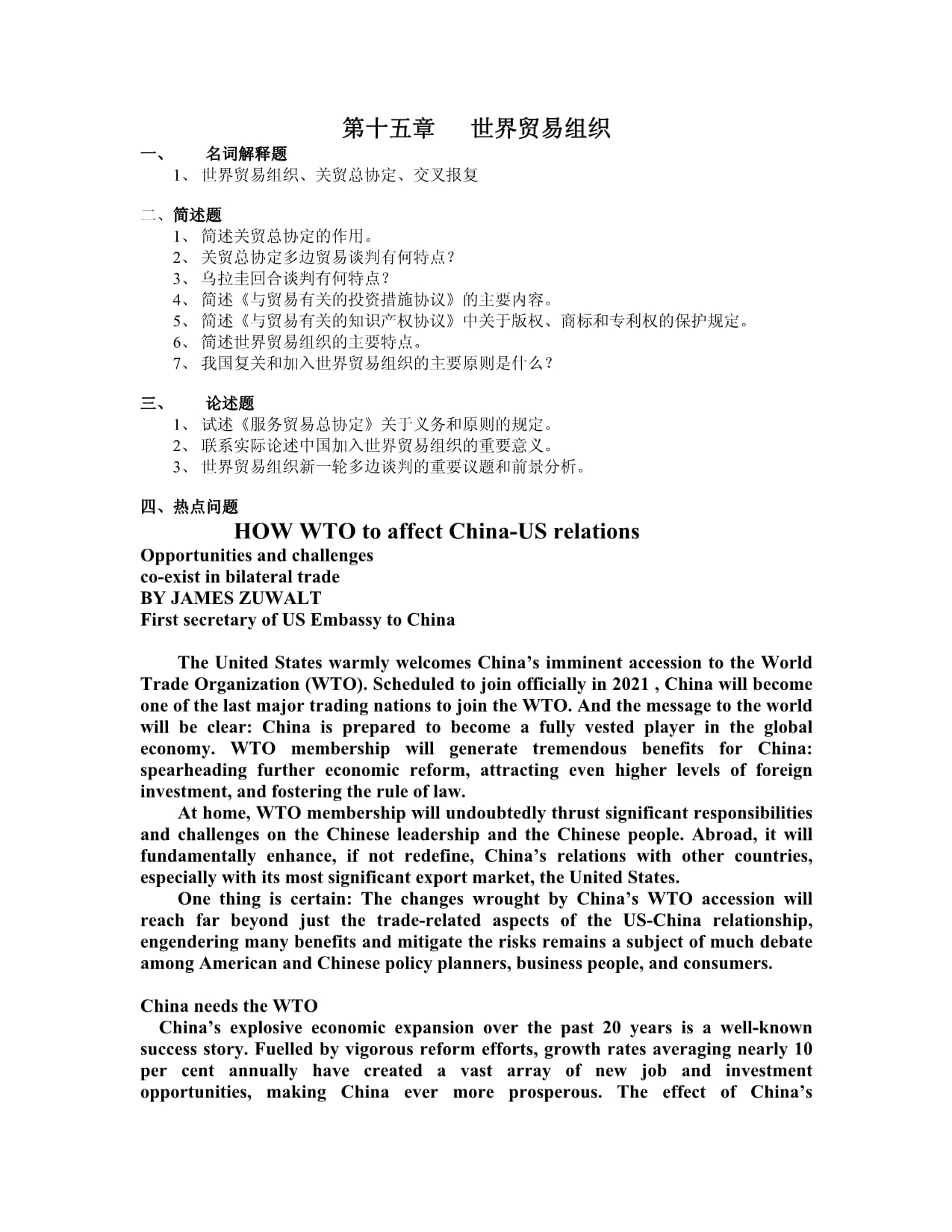
第十五章世界贸易组织名词解释题世界贸易组织、关贸总协定、交叉报复简述题简述关贸总协定的作用。关贸总协定多边贸易谈判有何特点?乌拉圭回合谈判有何特点?简述《与贸易有关的投资措施协议》的主要内容。简述《与贸易有关的知识产权协议》中关于版权、商标和专利权的保护规定。简述世界贸易组织的主要特点。我国复关和加入世界贸易组织的主要原则是什么?论述题试述《服务贸易总协定》关于义务和原则的规定。联系实际论述中国加入世界贸易组织的重要意义。世界贸易组织新一轮多边谈判的重要议题和前景分析。四、热点问题HOWWTOtoaffectChina-USrelationsOpportunitiesandchallengesco-existinbilateraltradeBYJAMESZUWALTFirstsecretaryofUSEmbassytoChinaTheUnitedStateswarmlywelcomesChina’simminentaccessiontotheWorldTradeOrganization(WTO).Scheduledtojoinofficiallyin2021,ChinawillbecomeoneofthelastmajortradingnationstojointheWTO.Andthemessagetotheworldwillbeclear:Chinaispreparedtobecomeafullyvestedplayerintheglobaleconomy.WTOmembershipwillgeneratetremendousbenefitsforChina:spearheadingfurthereconomicreform,attractingevenhigherlevelsofforeigninvestment,andfosteringtheruleoflaw.Athome,WTOmembershipwillundoubtedlythrustsignificantresponsibilitiesandchallengesontheChineseleadershipandtheChinesepeople.Abroad,itwillfundamentallyenhance,ifnotredefine,China’srelationswithothercountries,especiallywithitsmostsignificantexportmarket,theUnitedStates.Onethingiscertain:ThechangeswroughtbyChina’sWTOaccessionwillreachfarbeyondjustthetrade-relatedaspectsoftheUS-Chinarelationship,engenderingmanybenefitsandmitigatetherisksremainsasubjectofmuchdebateamongAmericanandChinesepolicyplanners,businesspeople,andconsumers.ChinaneedstheWTOChina’sexplosiveeconomicexpansionoverthepast20yearsisawell-knownsuccessstory.Fuelledbyvigorousreformefforts,growthratesaveragingnearly10percentannuallyhavecreatedavastarrayofnewjobandinvestmentopportunities,makingChinaevermoreprosperous.TheeffectofChina’stransformationfromaninward-looking,plannedeconomytoamoremarket-oriented,tradingpowerhousehasreverberatedthroughouttheglobaleconomy,influencingeverythingfromconsumers’choicestoinvestmentflows.Rapid-firegrowthhasnotbeencost-free,however.Inparticular,ithascastaharshlightonsomeofthestructuralweaknessesofChina’seconomicsystem,inagriculture,finance,andstate-ownedenterprisereform.ThedilemmaforChinahasbeen,andwillcontinuestobe,howbesttokeepthedualmomentumofeconomicgrowthandstructuralreformgoing.Inmanyrespects,WTOmembershipisChina’sbestoptionforstayingthecourse,forensuringthatneitherthepaceofeconomicgrowthnorofreformfalters.Astheworldeconomyhasbecomevastlymorecomplexandinterconnected,China’sparticipationinit,accordingtotherulesofinternationaltrade,hasbecomethatmuchmorecriticalnotonlyforChina,butfortheUnitedStates,Asia,andtheworld.AsaWTOmember,Chinawillbeabletoparticipateintheformulationofrulesthatgoverninternationaltradeandinvestment.Similarly,itwillbeabletodefenditstradeinterestsusingtheWTOdispute-settlementsystem.ChineseexporterswillbenefitfromthecertaintythattheirtradingpartnersmustobeyWTOrules.Thismeans,forexample,thatWTOmemberswillnotbeabletodiscriminateagainstChineseproductsintheirhomemarkets.WTOmembershipwillmakeChinaevenmoreattractivetoforeigninvestors.AndmoremoneyinvestedinChinameansmorehigh-payingjobs,moregovernmenttaxreceipts,andmoretechnologytransfers.WTOrulesaredesignedtofacilitateincreasedcompetitionineverysectoroftheeconomy.Chineseconsumerswillbethedirectbeneficiaries,ascompetitionencouragesalargerangeofchoices,lowerprices,andhigherquality,nottomentionagreaterawareness,andappreciationfor,intellectualpropertyrightsandconsumerrights.Globalcompetitionwillfostergainsinefficiencyandproductivity,whichwillstrengthenChina’seconomyovertime,andenhancetheabilityofChinesefirmstotakeonthebestmultinationalsinanymarket,inanypartoftheworld,China’seconomywillbenefitfromtheexpandedrangeofservices—insurance,finance,distribution—whichforeigncompanieswanttobringintoChinaafteritsWTOaccession.CompetitioninthisareawillinturnstimulateChina’shome-grownservicessector,givingcompaniesandconsumersanevenbroaderrangeofchoices.China’sresponsibilitiesWhileChinaispoisedtobenefitgreatlyfromWTO,itisimportanttokeepinmindthatWTOmembershipdoesnotonlyconveycertainrights,butalsospecificresponsibilities.Chinalabouredthrough15yearsoftoughnegotiations,particularlywiththeUnitedStatesandtheEuropeanUnion,toachieveWTOmembership.ThetimeandeffortinvolvedstandsasatestamenttoChina’sdeterminationtobecomeafully-integratedplayerintherules-basedglobaltradingregime.AlthoughthebattletoachievethevictoryofWTOaccessionwashard-fought,inmanyrespectsanotherequallyworthwhilebutdifficultchallengeconfrontsthenation.ChinaisintheprocessofmakingenormouschangestomeetitsWTOobligations—restructuringindustries,publishingpreviouslyinternallawsandregulations,establishingformalprocedurestoadjudicatedisputes,andlevellingtheplayingfieldforforeigncompanies.Ithasagreedtoslashtariffsandtoeliminateimportquotas,todismantleexportsubsidies,andhaspromisedtoopenserviceindustriestoforeigncompetition.SomeofthesechangeswillcomeimmediatelyuponChina’saccession;otherswillbephasedinoveraperiodofafewyears.WTOandUS-ChinatiesHowwellChinafulfilsitsobligationsofWTOmembershipwillhaveadirectbearingonthefuturedirectionofUS-Chinarelations.ItisintheinterestsofbothcountriestoavoidascenarioinwhichtradefrictionsareexacerbatedbyaninabilityorunwillingnesstomeetthemanycommitmentsChinahasmadetojointheWTO.Thatsaid,tradefrictionsbetweentheUSandChinawillnotgoawaywithWTOaccession.Ifanything,theymightincrease,atleastinitially.Thatisonlynaturalasthesizeandscopeofourtraderelationshipgrows.ChinaalreadyenjoysaburgeoningtradesurpluswiththeUS.TheUSandothergovernmentsareplayingavitalroleintryingtoavoidjustsuchascenariobyofferingChinaassistanceinmeetingitsWTOobligations.OurConsulateGeneralinShanghai,forexample,hasworkedwiththeUS-ChinaBusinessCounciltoputtogetheravideo-conferencingprogrammeinwhichAmericantrade-lawexpertsspeaktoChineseofficials.Similarly,ourEmbassyinBeijingisworkingwithBeijingUniversityandalocaldistance-learninginstitutiontoprovideon-lineWTOtrainingopportunitiesincommunitiesthroughoutChina.TheEuropeanUnionhasallocatedapproximatelyUS$23milliontobringChineseofficialsuptospeedonWTOrulesandconcepts,includingtranslationsforuseindomesticlegislation.WTOrulescanprotectChinaChina’shandlingoftradedisputeswithJapanprovesthecountryisn’tskilledenoughinusingrulesandregulationsoftheworldTradeOrganization(WTO)toprotectitsowninterests,saidanarticleintheJapaneseStudiesMagazine.ThelatesttradedisputewasprovokedbyJapaninAprilwhenitslappedimportcurbsonshiitakemushrooms,springonionsandrushestatamimatsfromChina.InJune,ChinaimposedpunitivetariffsonJapanese-madecars,mobilephonesandairconditioners.ThedisputecanbeviewedasanearlytestofhowChinawillmeetchallengesbroughtaboutbyitspendingWTOentry,thearticlesaid.OneproblemexposedisChina’sslowresponsetoJapan’saction.TheJapaneseGovernment,infact,startedrelevantinvestigationsforpossibleimportcurbsinasearlyDecember.Theseinvestigationswereconductedinanopenmanner.YettherewasnoChineseresponseuntilMarch27,whenJapanannounceditsnon-tariffprotectionmeasuresandintensifieditsquarantineofimportedfarmproduces.AnotherproblemdemonstratedisChina’sweaknessincollectinginformation.WhentheJapanesegovernmentbeganinvestigationsoncertainproductsandmaderelevantstatistics,theChinesegovernmentshouldhaveconductedtheirowninvestigationsonthetargetedproducts.Withthematerialscollected,ChinacouldhaveclarifiedmisinformationpublishedbyJapan.Furthermore,theeffectwouldhavehelpedChinaworkoutefficientcountermeasures.Today’stradewars,toagreatextent,areinformationwars.Acountrycannotconvincetheinternationalcommunitybytalkingabstracttheoriesandmustinsteadrelyonconcretedatatojustifyprotectivemeasures.Inthetradedispute,betweenChinaandJapan,Japanfloodedthemediawithstatistics.ChinesemediaalsohadtoquotefiguresreleasedbyJapanwhiletalkingaboutChina’sexportofthesethreeproducts.Therewasnoproofastowhetherthosefiguresareaccurate.WTOentrymeansbothopportunitiesandchallengestoChina.Butpeopleareplacingmoreexpectationsongainsthanonnecessarypreparationstomeetchallenges,thearticlewarned.AfteritbecomesaWTOmember,Chinawillencountersimilar,unavoidabletradedisputeswithothercountries.Togainanupperhandinhandlingdisputes,itisapressingtaskforChinatobecomefamiliarwithrulesandregulationsofWTOBeingblindtothegamerulesfortheWTOwillmakeChinaill-prepareditselfandleadittounintentionallybreaklaws,thearticlesaid.WhileChinahasbeenoutoftheWTO,thenationhassuffereddiscrimination.ButfairtreatmentwithintheWTOdependsontheskilleduseofrelevantrulesandregulations.Chineseenterprisesalsomustbecomemoreresponsible,thearticleurgedInthecurrentChina-Japantradedispute,itwastheJapanesenon-governmentalagriculturalorganizationsthatputforwardtheproblemfirst.JapanesepoliticianslaterimposedpressureontheJapaneseGovernment,whichfinallytooktheprotectivemeasures.Chineseenterprises,stillstuckintheshadowsoftheoldplannedeconomicsystem,havedependedheavilyonthegovernment.Thissituationmustbechanged,thearticlesaid.AfterjoiningtheWTO,Chinamustusebothgovernmentandenterprisestoassureinternationaltradingjustice.Thegovernmentisresponsibleformaintainingthestabilityofthedomesticmarketandprotectinginfantindustriesmustrealizefirstthattheirsectorsarethreatenedbysimilarproductsoverseasorunfairtreatmentabroad.Ifenterprisesfindforeigncompaniesaredumpingtheirproductsonthelocalmarketorresortingtounethicalcompetitivemeans,theyshouldreporttothegovernmentsoaprobecancommenceatonce.AfterenteringtheWTO,Chinamustalsodiversifyitsexportstoavoidrelianceonexportsofthesameproductstooneortwoparticularcountries.ChinacouldeasilyrunafoulofWTOruleswithoutmeaningtodoso.Forexample,ifChina’sexportexceeds3percentofacountry’stotalimportofacertainproduct,theimportantcountry,inlinewithWTOrules,maycurbtheimportofthatChineseproducts.Insomecircumstances,evenifitsexportsarecurbed,thepunishedcountryhasnorighttotakecountermeasureswithinthefirstthreeyears,thearticlesaid.AnoldailmentafflictingChina’sexportisthepricewaramongChineseenterprises.Totrytowinforeignorders,enterprisesviewitheachotherincuttingprices.Asaresult,theysuffergreatlossesinprofit.Atthesametime,foreignproducersmayaccuseChineseproducersofdumpingtheirproducts.AttentionmustbepaidtothisproblemafterChinabecomesaWTOmember,thearticlesaid.ItcannotbeChina’sresponsetoeverychallengingmarket.Finally,thegovernmentandnon-governmentaltradeassociationsshouldplayamoreactiveroleinprovidinginformationtoenterprises.Itisdifficultforanysingleenterprisetohaveagraspofthekindofinformationagovernmentorprivateagencycancollect,buthavingthisknowledgewillhelpChinaimmeasurablyWTO promptsbetterbusinessenvironmentChina’sentryintotheWorldTradeOrganization(WTO)willpromptthenationtoreviseitscurrentlawsandregulationsand,subsequently,improvetheenvironmentforforeigntradeandforeigninvestment,anarticleinBeijingReviewsaid.Chinahasapprovedaseriesofobligationstoopenitssocialsystem.ChineseleadershavesaidmanytimesthatChinawillstrictlyabidebyWTOrulesandearnestlyfulfillitspledges.ThesixmajorobligationsChinaistobearfollowingitsWTOentryareasfollows:ChinaistotreateachWTOmemberequally.Allindividualsandorganizationsinvolvedinforeigninvestment,includingindividualsandorganizationsthathaveneverinvestedorregisteredinChina,willenjoyatleastthesametreatmentasChineseenterprisesregardingtherightsoftrade.Chinaistoabolishthepracticeofdoubletrackpricingaswellasdifferenttreatmentsfordomesticallysoldgoodsandexportedgoods.Pricecontrolwillnotaimtoprovideprotectiontodomesticmanufacturersandservicecompanies.ChinaistomodifyexistingdomesticlegislationanddraftnewlawsinaunifiedandeffectivemannerinlinewiththeWTOAgreementsoastomeetrequirementsoftheWTOAgreement.ThreeyearsafterChina’SWTOentry,expectforahandfulofcases,allenterpriseswillhavetherighttoimportandexportgoodsandconducttradewithinthecustomsterritory.Farmproductswillhavenoexportsubsidiesofanysort.AfterChinafulfilsallitspledges,itsaveragetariffonfarmproductswilldropto15percent,whiletariffsofindustrialgoodswilldropto8.9percent.SubsequenttoChina’sWTOaccession,foreigncompaniesinvolvedinserviceswillbeallowedtoestablishequityjointventuresinChinawhich,nolongerlimitedinnumber,canprovideservicesinsomecities.FiveyearsafterWTOaccession,foreignfinancialinstitutionswillbeallowedtoproviderenminbiservicestoallChinesecustomers.ForeigninsurancecompaniescansetupnonlifeinsurancesubsidiariesorjointventuresinChina,andforeignbusinesseswillbeallowedtoestablishsolelyforeign-ownedsubsidiaries.TosuittheneedsofjoiningtheWTO,Chinahasbeenrevisingandimprovinglawsandregulationsinvolvingforeigntradeandeconomiccooperation.Itisexpectedthatby2021,alegalsystemofmarketeconomyinconformitywithChina’snationalconditionswilltakeshape.Numerousdecrees,regulationsandrulesstillneedtoberevisedforthesakeofchina’sWTOentry,saidZhangYuqing,directoroftheDepartmentofLawsandRegulationsundertheMinistryofForeignTradeandEconomicCo-operation(MOFTEC).Morethan2,000bitsofregulationsneedtoberevised,onebyone.AmongthoselawsthathaveundergonethemostrevisionsaretheLawonChina-ForeignEquityJointVentures,theLawonChinese-ForeignContractualJointVenturesandtheLawonForeign-CapitalEnterprises,saidHuJingyan,directorofMOFTEC’sForeigninvestmentdepartment.HurevealedthatChinawouldabolishthreeinflexiblerulesrequiredofforeign-fundedenterprisesafteritsWTOaccession,regardinglocalproportion,foreignexchangebalanceandexportingproportion.ExportersforecastthatChina’sWTOaccessionwillleadtoanewroundofforeigninvestmentinChinaandthatWTOentrymarksthefulllinkageofChinawiththeinternationalcommunity.TheChineseeconomicsystemandChinesepolicies,lawsandregulationsregardingforeigninvestmentwillbecomelessambiguous.ThiswillstrengthentheconfidenceofforeigninvestorsintheChinesemarket,thearticlesaid.Butbeforethiscanhappen,China’scurrentpoliciesaimingtoattractforeigninvestmentneedrevisions.Forinstance,therearesomeinappropriaterestrictionsonforeign-fundedenterprisesregardingbuyingimportedgoods.AftertheWTOentry,thesepracticeswillbechangedgradually.Thecurrentsystemforexaminingandapprovingforeigninvestmentalsowillbereformedtoincreasethetransparencyofexaminationandapproval.AfteritsWTOentry,Chinawillregularlyreportitschangesinforeigninvestmentpoliciestotheworldtradebody.Itwillestablishamechanismforissuingpoliciesrelatedtoforeigninvestment,anddesignatedmediawillpublicizetherelatedpolicies.Examinationandapprovalofforeigninvestmentwillbeconductedinaccordancewithpromulgatedlawsandregulations.Theproceduresofexaminationandapprovalwillbesimplebuteffectiveandtheprocessshallbeopen.ImplementationofnationaltreatmentfollowingWTOentryisalsoexpectedandwillexemptforeign-fundedenterprisesfrommanyproblems.ThiswillgreatlyboostforeigninvestmentinChina.Theopeningoffinance,insurance,telecoms,commerce,tourism,foreigntrade,shipping,construction,education,publichealthandpublishingwillhasten.Theabsolutevalueandratioofforeigninvestmentattractedbytheservicesectorwillexperienceanobviousincrease,whichisexpectedtopushupthetotalamountofforeigndirectinvestment.WTOentrywillforceChinatoadoptuniversallyacceptedchannelsforattractingforeigninvestment,suchasmergersandacquisitionsandsecuritiesinvestment.Thatwillfurtherexpandthescaleofforeigninvestment.Inastep-by-stepwayandundertheprerequisiteofguaranteedsupervision,ChinamaygraduallyallowforeigninvestorstoparticipateintheA-sharemarketbymeansofsecuritiesinvestment.五、案例分析案例一印度申诉土耳其对纺织品与服装的限制违背了非歧视原则案例概述根据土耳其及欧盟成立关税同盟的协议,土耳其在纺织品与服装产品上与欧盟一样实行“大体上相同”的贸易政策。欧盟根据《纺织品与服装协议》(ATC)对包括印度在内的部分国家的纺织品及服装产品实施了进口数量限制。作为与欧盟建立关税同盟,在纺织品与服装上实行与欧盟“大体上相同”的政策结果,土耳其对印度的19个种类的纺织品与服装实行了数量限制。印度因此向WTO争端解决机构(DSB)申诉土耳其,请求成立专家小组来调查此案。2021年3月13日,DSB成立专家小组对此案进行调查。泰国和美国等以第三方身份参加。印度认为,土耳其实施的数量限制违背了1994年GATT第11条“普遍取消数量限制原则”、第13条“非歧视数量限制原则”和《纺织品与服装协议》第2条第4款的规定。土耳其则争辩说,它在成立关税同盟时实施的数量限制符合1994年GATT第24条的规定。专家小组经过调查后,在2021年5月31日分发的报告中裁定,土耳其对印度纺织品与服装实施的数量限制不符合1994年GATT第11条“普遍取消数量限制原则”、第13条“非歧视数量限制原则”和《纺织品与服装协议》第2条第4款的规定。专家小组否决了土耳其关于1994年GATT第24条授予它在与欧盟成立关税同盟后可以违背1994年GATT及(纺织品与服装协议》有关规定实行数量限制的辩护。2021年7月26日,土耳其通知DSB,对专家小组在法律解释上存在的问题提出上诉。土耳其没有上诉专家小组关于其数量限制措施不符合1994年GATT第11条、第13条和《纺织品与服装协议》第2条第4款不一致的裁定,只上诉专家小组裁定它不能依据1994年GATT第24条规定实施的数量限制措施是合理的。上诉机构维持专家小组的裁定:在此案中,不能根据1994年GATT第24条来判决土耳其的数量限制措施是合理的。然而,上诉机构推翻了专家小组对1994年GATT第24条作出的解释。上诉机构裁定,根据1994年GATT第24条第5款引文,在一定条件下可以根据1994年GATT第24条裁定与GATT不一致的措施是合理的。辩护方可以根据1994年GATT第24条认定限制措施是合理的,但必须满足两个条件:第一,在关税同盟成立时,这样的限制措施必须完全符合GATT第24条的规定,特别是符合该条第5款及第8款的规定;第二,成员必须证明如果成员没有被允许实施这一措施,关税同盟的成立已经受到阻碍。对于第一个条件,上诉机构认为,在此案中专家小组做出了土耳其及欧盟成立关税同盟的安排完全满足1994年GATT第24条的假定。然而,这个假定没有被土耳其上诉,因而没有在上诉机构按程序讨论。上诉机构对专家小组进行了批评,认为专家小组在审查措施是否应根据1994年第24条来判决时,需要WTO成员证明这个措施在关税同盟成立时完全满足关税同盟的要求c对于第二个条件,上诉机构裁定,土耳其没有证明它与欧盟之间关税同盟的成立在没有采取数量限制措施时会受到阻碍,土耳其还可以利用可替代措施,如运用原产地规则来证明达到限制的目的。上诉机构得出结论,根据1994年GATT第24条,土耳其对印度的纺织品与服装的进口限制措施不合理。专家小组裁定土耳其的行动与它所需承担1994年GATT第11条、第13条和《纺织品与服装协议》第2条第4款规定的义务不一致是正确的。最后,DSB通过了上诉机构的报告及上诉机构修改后的专家小组报告。评析印度申诉土耳其对纺织品与服装的限制问题,属于非歧视原则问题。非歧视原则是世界贸易组织各项协定、协议中最重要的原则。在世界贸易组织中,非歧视原则主要是通过最惠国待遇原则和国民待遇原则来实现的。而非关税壁垒主要体现在数量限制措施、进口许可制程序的繁简、海关估价的方法、手续及程序、贸易技术壁垒的规定、原产地规则及装船前检验的规则等方面。在这些非关税壁垒中,最显著的是数量限制(QRS)。数量限制措施指对出口产品的数量加以限制的措施,其形式主要有配额、进口许可证、自动出口限制和禁止4种。数量限制这种贸易壁垒长期为各国所宠爱,各国不断用它来保护受到进口冲击的国内工业,特别是农业、纺织业和钢铁等产业,这主要是因为数量限制实施起来较容易、简单,效果明显。但是,相对其他措施,数量限制的保护效果代价较高,缺少透明度,成本难以估量,对国际贸易扭曲较大。GATT一直强调应通过关税而不是通过数量限制及其他非关税措施来保护国内工业,显然,数量限制违背了GATT精神,所以,取消数量限制成为GATT追求的目标之一。GATT第11条明确规定:“任何成员除征收税款或者其他费用以外,不得设立或维持配额、采用进出口许可证或其他措施以限制或禁止其他成员领土输入或者向其他成员领土输出或销售出口产品。”基于各国情况的复杂性,GATT认识到,完全取消数量限制是不切实际的,为了对数量限制更好地进行管理与监管,GATT在强调取消数量限制的同时,规定了部分例外,主要有:GATT第11条第2款规定的例外;国际收支平衡保障例外;特定工业保护例外;数量限制的非歧视原则例外。GATT第11条第2款规定了三种例外:(1)“为防止或缓和输出成员的粮食或其他必需品(包括纺织品)中的严重缺乏而临时实施的禁止出口或限制出口。”在这一例外中,值得注意的有四点:第一,“防止或缓和”意味着采取的限制措施可以在事件发生前或事件发生后;第二,“其他必需品”(包括纺织品)指本国可枯竭的资源;第三,“严重缺乏”暗含季节性食品由于受国外售价的上涨而引起国内售价的暴涨而导致的缺乏,且这种缺乏是“严重”的;第四,临时实施指禁止出口或限制出口的措施是临时而非长久、永恒地适用,一旦事情发生转机,回到正常情况,呀袄立即撤消这种措施。(2)“为实施国际贸易上初级产品分类、分级和销售的标准及条例,必须实施的禁止进出口或限制进出口。关于该例外,GATT第16条规定,“初级产品”应理解为天然形态的农业、林业、渔业或矿业产品,或为在国际贸易中能大量销售而根据习惯性需要进行过加工的上述产品(包括纺织品)。(3)对任何形式的农渔产品(包括纺织品)有必要实施的进口限制:(a)限制相同国内产品允许生产或销售的数量,或者若相同国内产品的产量不大,限制可直接取代进口产品的国内产品的允许生产或销售数量的政府措施;(b)通过采用免费或低于现行市场价格的办法,将过剩产品供国内某阶层消费,以消除国内相同产品的暂时剩余,或者相同国内产品若产量不是很大,以消除能直接代替进口产品的国内产品的暂时过剩的政府措施;(C)限制生产是全部或主要地直接依赖于进口,而国内产量相对有限的动物产品允许生产的数量的政府措施。任何成员在依照第(3)款对任何产品的进口实行限制时,应把所设定的指定时期内准许进口的产品数量或价值以及可能的变动进行公布。根据(a)项实施的限制,不应使产品的进口总量与其国内生产总量间的比例低于如不执行限制可以合理预期达到的比例。成员在确定这个比例时,对前一有代表性时期的比例及可能曾经影响或正在影响这个产品贸易的任何特殊因素,均应给予适当的考虑。为了澄清该条款,我们把上述对农渔产品(包括纺织品)实行限制的条件进行简化,即限制农渔产品(包括纺织品)进口必须满足下列几个条件:第一,如果对国内农渔产品(包括纺织品)进行限制,可同时对进口农渔产品(包括纺织品)进行限制;第二,出于解决过剩产品的目的,以补贴价或免费向一定范围的人提供国内产品,可以实施进口限制;第三,对国内农渔产品(包括纺织品)实施限制,则可对进口农渔产品(包括纺织品)实施限制;第四,对某项产品进行限制前,必须公布相关的情况;第五,据(a)实施的限制,应维持进口总量与国内产品总量之间合理的比例。该款实质上为农渔产品(包括纺织品)开了一扇大门,各成员可以以限制生产的名义,来对本国国内生产者及市场进行保护。同时,由于这一条款规定较晦涩且存在漏洞,因而在实践中长期被引用。这些漏洞主要有:(1)农渔产品(包括纺织品)具体是指哪些产品,尽管用“任何形式”作了限定,但在实践中仍会产生分歧。(2)采取措施的标准。尽管该款规定了具体的条件,在满足这些条件的前提下可以采取限制,但可以看出,该款条文过于晦涩,易产生分歧,且缺乏规范力度。如何对采取措施的标准进行规定,是WTO亟待解决的问题之一。思考题什么是数量限制措施?它对国际贸易有何影响?GATT第11条第2款规定了数量限制的三种例外,对此,你有何看法?案例二英法等国对日本采用“互不适用条款”是否违背了非歧视原则概述1955年日本加入GATT时,有15个国家由于担心日本物美价廉的纺织品会对国内的纺织品行业造成损害,于是对日本援引互不适用条款,这些国家包括英国、法国及它们的附属国,部分国家在后来加入GATT时也对日本援引了第35条互不适用条款。尔后,日本在加人GATT后,经过努力,使这些国家中的大部分都撤销了对日本行使这一条款的法律权力,与它们建立了GATT关系。评析英法等多国对日本采用“互不适用条款”问题,属于非歧视原则问题。在GATT中,非歧视原则主要是通过最惠国待遇原则和国民待遇原则来实现的,但也有例外,即互不适用条款。GATT第35条被称为互不适用条款。它规定,在任何成员与任何其他一个成员之间不适用协定或不适用本协定第2条MFN原则,只要:(a)两个成员之间没有进行过关税谈判;(b)该两个成员的任何成员在其他一方成为成员时,不同意对它实施GATT规则。在特定情况下,经两个成员中任何一方提出请示,缔约方全体可以审查本条款执行情况,并提出适当的建议。这一例外属于程序上的例外。根据此条款规定可以认为,援引互不适用条款需要满足两个条件:第一,两成员之间未进行关税减让谈判。关税减让是GATT自由化的主要手段,两成员之间未进行关税减让谈判意味着两成员并未在GATT框架下达成自由化协定,当然也没有必要承担相应的义务。但是,关于如何才算进行关税减让谈判,GATT没有明确规定,这是该条款的一个漏洞。在WTO历史上,长期以关税谈判小组交换项目清单作为“进行了谈判”的依据,但波兰、罗马尼亚在加入时并没有进行谈判,打破了这一常规。第二,成员中的任何成员在另一方成为成员时不同意对其适用GATT。关于这一条件要注意三点,一是提出互不适用要求的可以是“任何一方”,即可以是新加入的一方,也可以是创始成员;二是一成员可以同时对多个成员援引互不适用条款,一成员也有可能同时被多个成员援引互不适用条款;三是提出互不适用要求是在新成员加入时,已成为GATT成员的成员不能提出互不适用。GATT第35条第2款规定了审查机制,在成员一方提出请求时,缔约方全体可以在特定情况下检查本条规定的执行情况,并提出适当的建议,这主要是为了防止一成员可能给予另一成员不公正待遇而设立的,希望缔约方全体能对此进行监督与约束。《建立WTO协定》对互不适用条款进行了修改,作出了更严格的规定:第一,在WTO协定生效之前加入,并已经根据1947年GATT第35条对有关成员实施互不适用的情况下,WTO互不适用条款才对创始成员有效。第二,如果创始成员要求对申请加入方适用互不适用条款,必须在加入方的加入议定书生效前向部长会议提出,并征得部长同意。此外,成员在与申请加入方进行了谈判后仍可以实施互不适用条款,这一点对申请加入方很不利。第三,在某些特定倩况下,如有成员要求,部长会议可以评审互不适用条款的实施情况,并提出适当建议。对于诸边贸易协议在成员之间的互不适用应按协议的相关规定处理。思考题什么是“互不适用”条款?援引“互不适用”条款必须满足什么条件?“互不适用”条款会对国际贸易带来什么影响?
宝贝计划专卖店创业计划书企业名称: __宝贝计划婴儿用品专卖店创业者姓名: _________________________________________日期: __________________________________________通信地址: _________________________________________邮政编码: __________________________________________电话: ____________________________________________传真: __________________________________________电子邮件: __________________________________________目录一、项目介绍------------------------------------3二、市场分析------------------------------------3三、成本预算------------------------------------3四、盈利状况------------------------------------4五、市场风险预测----------------------------------4六、人员机构配置----------------------------------5七、市场营销策略----------------------------------5宝贝计划婴儿用品专卖店计划书项目介绍:项目名称:宝贝计划婴儿用品专卖店经营范围:以出租和出售婴幼儿童车、童床、儿童玩具、婴儿日常用品和孕前孕后的孕妇培训为主,兼做婴儿游泳馆和家政服务信息等。项目投资:10—14万元回收成本期限:15个月(预计)样板店地址:桂林市兴安县(具体地址待定)项目概况:先组建宝贝计划婴儿用品总店,在此基础上,创办一个以片为依托的婴儿用品连锁店。企业宗旨:一切为了宝贝计划。二、市场分析:(一)市场需求分析:1、玩具是孩子的天使,孩子是父母的心肝宝贝。父母对自己孩子的投入是心甘情愿的,但由于各种原因,又不能完全满足孩子对玩具的占有欲望。同时,由于孩子的天性,对玩具喜新厌旧,一个几百元的玩具玩几天就不感兴趣了。而市场上层出不穷的高价玩具,都是孩子永不满足的需求,这样促使了儿童玩具出租行业的萌芽和发展。比如婴幼儿大都需要童车,低档童车价格大约在60—100元,中档童车价格大约在150~300元之间,高档一点的在500元以上,而一部质量较好的童车起码可以用三五年,家庭购买的童车平均使用期为一年左右,不买童车不行,买吧,用完后又很难处理,而且又浪费,所以本店的特色是——既可以出租而可以出售的方法。相似的用品不仅仅局限于童车童床,还有学步车等等。如果开一间婴幼儿童童车童床出租出售店,可以给消费一般的家庭带来实惠,生意肯定兴隆。2、孕前孕后培训也是一个新兴的行业,据市场调查,在此之前没有任何商家以店的形式对准爸爸和准妈妈进行。因为现在的准妈妈准爸爸无法科学的照顾自己的孩子和孕妇,通过培训后,使其能够正确的操作。(二)目标群体分析:儿童车、童床、婴儿日常用品0~2岁的婴儿。由于出售的儿童车、童床、婴儿日常用品品种繁多,档次繁多,适合于各种不同层次的家庭孩子。选择在县级以上城市开店,可以说明该城市的人均家庭状况一般在小康水平或小康水平以上,对出租玩具的承受能力均没有任何问题。孕妇的孕前孕后培训主要是针对现在准妈妈准爸爸开设的课程,主要是产前的身体锻炼,饮食合理搭配及科学的锻炼;产后的小孩护理及营养搭配,常见的小孩注意事项等方面知识,让准妈妈准爸爸们科学的呵护自己的小孩。(三)竞争对手的分析:目前兴安县出售出租婴幼儿童车、童床、儿童玩具、婴儿日常用品为一体的公司或店铺寥寥无几,现在的店一本是单一性的,不是集中为一体的,而且这样做也是一个新兴的行业,我们应该有一种先人为主的优势,特别由总店然后发展成一片区为分店的一家连锁店。三、成本预算(一)样板店的成本预算15000元样板店启动资金大约在7万元左右,具体安排:(1)办理工商、税务登记等费用:200元(
温馨提示
- 1. 本站所有资源如无特殊说明,都需要本地电脑安装OFFICE2007和PDF阅读器。图纸软件为CAD,CAXA,PROE,UG,SolidWorks等.压缩文件请下载最新的WinRAR软件解压。
- 2. 本站的文档不包含任何第三方提供的附件图纸等,如果需要附件,请联系上传者。文件的所有权益归上传用户所有。
- 3. 本站RAR压缩包中若带图纸,网页内容里面会有图纸预览,若没有图纸预览就没有图纸。
- 4. 未经权益所有人同意不得将文件中的内容挪作商业或盈利用途。
- 5. 人人文库网仅提供信息存储空间,仅对用户上传内容的表现方式做保护处理,对用户上传分享的文档内容本身不做任何修改或编辑,并不能对任何下载内容负责。
- 6. 下载文件中如有侵权或不适当内容,请与我们联系,我们立即纠正。
- 7. 本站不保证下载资源的准确性、安全性和完整性, 同时也不承担用户因使用这些下载资源对自己和他人造成任何形式的伤害或损失。
最新文档
- 2026年桥梁景观设计与环境融合
- 2026年未来土木工程职业发展的趋势
- 电力线路复工安全培训课件
- 2026年绿色建筑的供电系统与节能技术
- 针灸基础知识
- 血液灌流患者护理查房
- 肺部疾病中医治疗
- 电力电网安全培训课件
- 快乐阅读共建文明校园话题作文15篇
- 企业低碳节能成果维护承诺书3篇
- 贵州省贵阳市2023-2024学年高一上学期期末考试语文试卷(含答案)
- 电气类仪器仪表使用
- 老年医学发展与挑战
- 9.2奉献社会我践行课件-2025-2026学年统编版 道德与法治 八年级上册
- 烟花爆竹零售店安全生产责任制
- 2025江苏苏州市昆山钞票纸业有限公司招聘10人笔试历年参考题库附带答案详解
- 商业中庭防坠网施工方案
- 交付异常应急预案
- 砌体工程监理实施细则及操作规范
- GB/T 222-2025钢及合金成品化学成分允许偏差
- 方太企业培训课件
评论
0/150
提交评论