




版权说明:本文档由用户提供并上传,收益归属内容提供方,若内容存在侵权,请进行举报或认领
文档简介
Chapter5
DynamicsofParticleMainContents§5.1Newton’sLawsofMotion§5.2DifferentialEquationsofmotionofaParticle
§5.3ThetwotypesofbasicproblemsofparticlekineticsKineticsofaParticle
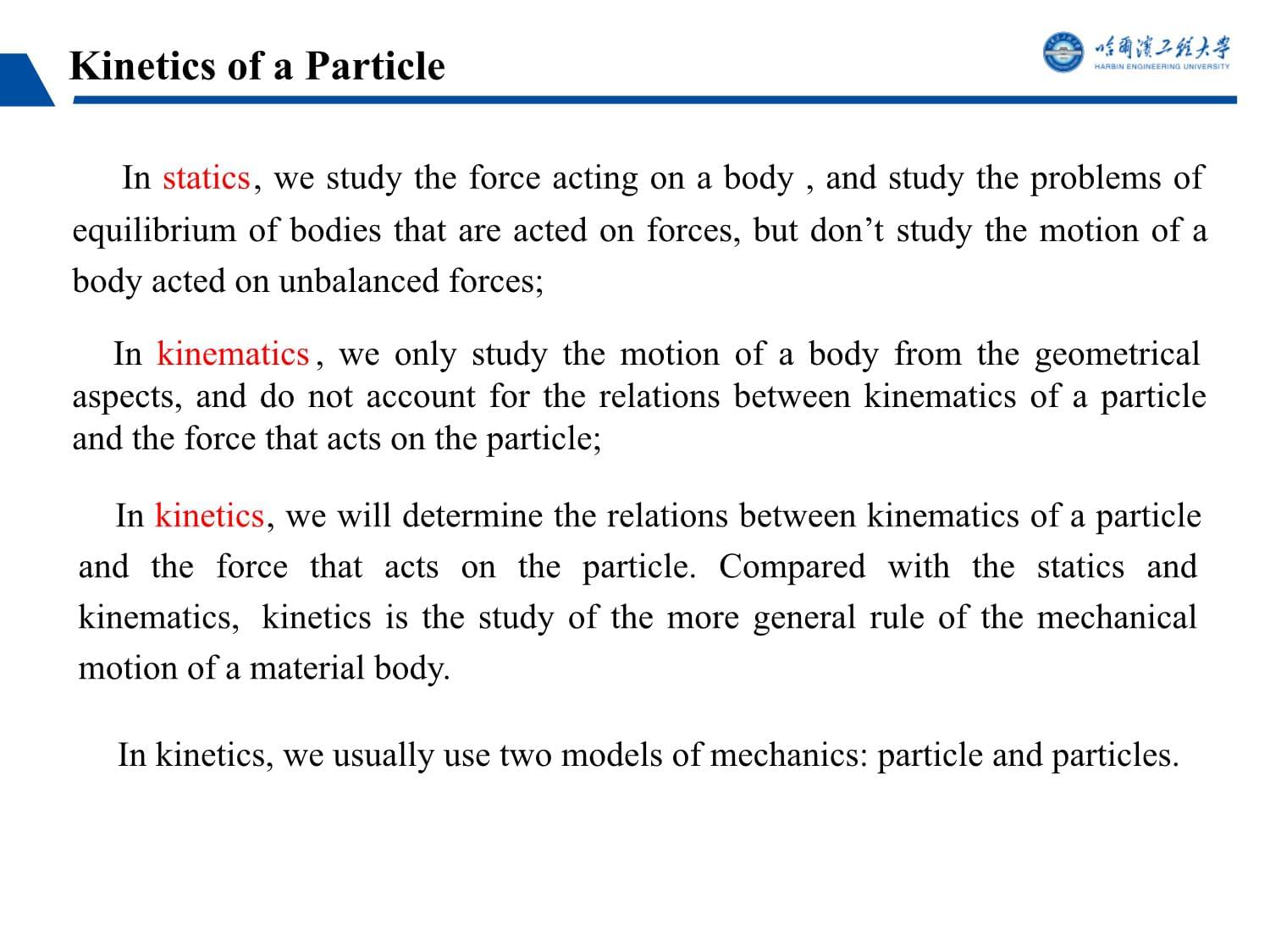
Instatics,westudytheforceactingonabody,andstudytheproblemsofequilibriumofbodiesthatareactedonforces,butdon’tstudythemotionofabodyactedonunbalancedforces;Inkinematics,weonlystudythemotionofabodyfromthegeometricalaspects,anddonotaccountfortherelationsbetweenkinematicsofaparticleandtheforcethatactsontheparticle;Inkinetics,wewilldeterminetherelationsbetweenkinematicsofaparticleandtheforcethatactsontheparticle.Comparedwiththestaticsandkinematics,kineticsisthestudyofthemoregeneralruleofthemechanicalmotionofamaterialbody.Inkinetics,weusuallyusetwomodelsofmechanics:particleandparticles.Whentheshapeandsizeofabodyisnotsignificant;arigidbodywithtranslationalmotionmaybedefinedasaparticle,theparticleconcentrateallmassoftherigidbody,andlieinthecenterofmassoftherigidbody;Sometimes,thebodymaybemodeledasaparticle,andtherotationalmotionofthebodycanbeignored;Aparticle:aparticlehasamassbutnegligiblesizeandshape.Specifically,atwhatpointcanabodybeabstractedandsimplifiedasaparticle?Forexample,instudyingthemotionoftheeartharoundthesun,itispermissibletoconsidertheearthasaparticle.KineticsofaParticleAsystemofparticles:asystemcomposedoffiniteorinfiniteparticlescontactedeachother.Ifabodycannotbestudiedasaparticle,itmustbeaccountedasasystemofparticles.Theconceptofasystemofparticlesisveryuniversal,itincludesarigidbody,adeformablebody,andasystemcomposedofmanyparticlesandbodies.
KineticsofaParticle
Kineticscanbedividedintotwoparts:kineticsofaparticleandkineticsofasystemofparticles(includekineticsofrigidbodies).
Inthischapterwediscusskineticsofaparticle,thatistodeterminetherelationsbetweenkinematicsofaparticleandtheforcethatactsontheparticle.Asfundamentalsofothertheoryofkinetics,kineticsofaparticlebasedonthefundamentalsofNewton’sthreelaws.Thischapteremphasizehowtosolvethetwotypesofproblemsofparticlekineticsapplyingbasicequationsofkineticsandusingmethodsofdifferentialandintegralcalculus.KineticsofaParticle§5.1Newton’sLawsofMotionNewtonfirstlaw(inertialaw):
Intheabsenceofappliedforces,aparticleoriginallyatrestormovingwithconstantspeedinastraightlinewillremainatrestorcontinuetomovewithconstantspeedinastraightline.Inertia:apropertyofmatterbywhichitcontinuesinitsexistingstateofrestoruniformmotioninastraightline,unlessthatstateischangedbyanexternalforce.Therefore,thislawisalsocalledtheinertialaw.Newtonsecondlaw:Ifaparticleissubjectedtoaforce,theparticlewillbeaccelerated.Theaccelerationoftheparticlewillbeinthedirectionoftheforce,andthemagnitudeoftheaccelerationwillbeproportionaltothemagnitudeoftheforceandinverselyproportionaltothemassoftheparticle.Newtonsecondlawmaybeexpressedmathematicallyasfollows.§5.1Newton’sLawsofMotionorTheaboveformulaisthebasicequationforsolvingdynamicproblems,whichiscalledthebasicdynamicequation.Thisformuladiscribestherelationshipbetweenthemotionofaparticleandtheforcesactingontheparticle.
Newtonthirdlaw(thelawofactionandreaction):Foreveryaction,thereisanequalandoppositereaction;thatis,theforcesofinteractionbetweentwoparticlesareequalinmagnitudeandoppositeindirection,andcollinear.Itshouldbenotedthatthefirsttwolawsinthefundamentalequationsofdynamicsonlyapplyininertialcoordinates.Newtonthirdlawhasnothingtodowiththeselectionofcoordinatesystems,anditappliestoallcoordinatesystems.§5.1Newton’sLawsofMotionMechanicalsystemofunits
Inmechanics,weusuallyuseInternationalsystemofunits(SI).IntheSIsystem,allunitsaredividedintothreecategoriesbaseunits,derivedunitsandauxiliaryunits.ThebasedimensionsintheSIsystemaremass,lengthandtime,andthebaseunitsarekilogram(kg),meter(m)andsecond(s).Aunitofforceisderivedunits,beingcalledNewton(N).OneNewtonforcemakeonekilogramofmassgenerateonemeter/second2ofaccelerate,thatisRadianisanauxiliaryunit,canbeusedtoformderivedunits,forexampleangularvelocityunitandangularaccelerationunit,andsoon.§5.1Newton’sLawsofMotionInengineering,weoftenuseengineeringsystemofunits.Thebasedimensionsinengineeringsystemofunitsareforcelengthandtime,andthebaseunitsarekilogramforce(kgf),meter(m)andsecond(s).Massunitisderivedunits,whenonekilogramforcemakeabodygenerateonemeter/second2ofaccelerate,themassofthebodyisoneengineeringunitmass.Thatis§5.1Newton’sLawsofMotionWhenonekilogramforce(9.80665Newton)generateacceleration,themassis9.80665kilogram,hence1massofengineeringunitmass=9.80665kilogram≈9.8kilogramOnekilogramforce(kgf)isthegravityactingonabodythathasonekilogramofmassatalatitudeofofthesea.Hence§5.1Newton’sLawsofMotionThefundamentalequationsofmotionarerepresentedasequationsindifferentialform,knownasthedifferentialequationsofmotionofaparticle.1.VectorformWhenaparticlemovesinanarbitraryspatialcurve,itspositionisrepresentedbythevectordiameter
derivedfromanarbitraryspatialfixedpointO,asshowninthefigure.§5.2DifferentialEquationsofmotionofaParticle
2.Formsinrectangularcoordinates§5.2DifferentialEquationsofmotionofaParticle
3.Formsinpathn-tcoordinates§5.2DifferentialEquationsofmotionofaParticle
Applyingthedifferentialequationsofmotionofaparticlewecansolvetwotypesofproblemsofparticlekinetics.§5.3ThetwotypesofbasicproblemsofparticlekineticsThefirstbasicproblem:knowingthemotionofaparticle,todeterminetheforceactingontheparticle.Thatis,knowingequationsofmotionofaparticle,thesecondderivativewithrespecttotimeofthepositionvectoriscalledtheacceleration,whichissubstitutedintothefundamentalequationsofmotionofaparticle,weobtaintheforceactingontheparticle.Thesecondbasicproblem:knowingtheforceactingonaparticle,todeterminethemotionoftheparticle.(forexample,todeterminethevelocity,trajectoryandequationsofmotionofaparticleandsoon).Inthefundamentalequationsofmotionofaparticle,knowingtheforceactingonaparticle,wecanobtaintheaccelerationofthemotionoftheparticle,todeterminethevelocity,trajectory,equationsofmotionofaparticlebytheaccelerationistheintegralcalculationproblem。Example
5-1
§5.3ThetwotypesofbasicproblemsofparticlekineticsThefollowingexamplesarehowtosolvetwotypesofproblemsofparticlekineticsbyapplyingthedifferentialequationsofmotionofaparticle.,Example
5-1Solution:Firstly,choosetheparticleMastheobjectofstudy,theparticleMdoesplumb-rectilinearmotion,choosethetrajectorylineastherectangularcoordinateaxis,andthedownwarddirectionispositive.ThenputtheparticleMonthegeneralpositionofthemotiontodrawitsforcediagram.TheforcesontheparticleinthispositionaregravityPanddielectricresistanceR.ThenthedifferentialequationofmotionoftheparticleMinrectangularcoordinateiswherePxandRxaretheprojectionsofPandRontheOxaxis,respectively.wehave§5.3ThetwotypesofbasicproblemsofparticlekineticsFromtheknownequationofmotionofthemassExample
5-1ThedifferentialequationofmotioncanthenbewrittenasFromtheknownequationofmotionoftheparticlewegetso,therewas§5.3ThetwotypesofbasicproblemsofparticlekineticsExample
5-2Aparticleofmassmunderahorizontalforce
movesalongthehorizontallinefromrest.Determinetheequationofmotionoftheparticle.when
,aswellasThusgetting
Solution:Fortheproblem,forceisknown,andweneedtosolvemotion.Theforceisadiscontinuoustimefunction.Theobjectofstudyisaparticle,whichisrectilinearlymoving,andtheequationispresentedalongthedirectionofmotion.
§5.3ThetwotypesofbasicproblemsofparticlekineticsExample
5-2Thus,theequationofmotionoftheparticleiswhen
,thevelocityoftheparticle
,positionoftheparticle
thesearetheinitialconditionsat.when
,
,so
Fromtheinitialconditionsat
,ThusTheforceinthisproblemisadiscontinuousfunctionoftime,sotheanalysisshouldbesegmented,whilepayingattentiontotheinitialconditionsofeachsegment.§5.3ThetwotypesofbasicproblemsofparticlekineticsExample5-3
Solution:Taketheinitialpositionoftheobjectastheorigin,andbuildthecoordinatesystemalongthedirectionoftheobject'smotion.Motionanalysis:rectilinearmotion.
§5.3ThetwotypesofbasicproblemsofparticlekineticsEstablishdifferentialequationsofmotion:Example
5-3useSubstitutingintothedifferentialequationofmotionyieldsthusso
§5.3ThetwotypesofbasicproblemsofparticlekineticsthusExample
5-3Integrateoncemoreandget
soConsideringthatx=0att=0,wegetC3=9
§5.3ThetwotypesofbasicproblemsofparticlekineticsxyOABφβωExample
5-4Acrank-guidemechanismisshowninfigure.TheangularvelocityofthecrankOAisconstant,lengthOA=r,lengthoftheconnectingrodisAB=l.Ifλ=r/lissmaller,thepointOistheoriginofthecoordinatesystem,theequationofmotionofsliderBmaybewrittenapproximatelyasfollows:Themassofthesliderisdenotedbynotationm,
NeglectfrictionandthemassoftheconnectingrodAB,whenand,respectively,determinetheforceactingattheconnectingrodAB.§5.3ThetwotypesofbasicproblemsofparticlekineticsxBβxyOABφβωExample
5-4SoSolution:ConsideringthesliderB.Whenφ=ωt,thefree-bodydiagram(FBD)ofthesliderBshowninfigure,wheretherod(AB)istwoforcemember.Writingtheequationofmoti
温馨提示
- 1. 本站所有资源如无特殊说明,都需要本地电脑安装OFFICE2007和PDF阅读器。图纸软件为CAD,CAXA,PROE,UG,SolidWorks等.压缩文件请下载最新的WinRAR软件解压。
- 2. 本站的文档不包含任何第三方提供的附件图纸等,如果需要附件,请联系上传者。文件的所有权益归上传用户所有。
- 3. 本站RAR压缩包中若带图纸,网页内容里面会有图纸预览,若没有图纸预览就没有图纸。
- 4. 未经权益所有人同意不得将文件中的内容挪作商业或盈利用途。
- 5. 人人文库网仅提供信息存储空间,仅对用户上传内容的表现方式做保护处理,对用户上传分享的文档内容本身不做任何修改或编辑,并不能对任何下载内容负责。
- 6. 下载文件中如有侵权或不适当内容,请与我们联系,我们立即纠正。
- 7. 本站不保证下载资源的准确性、安全性和完整性, 同时也不承担用户因使用这些下载资源对自己和他人造成任何形式的伤害或损失。
最新文档
- 辽宁省辽阳市高级统计师资格考试(高级统计实务与案例分析)试题库及答案(2026年)
- 黑龙江省2026年全国成人高等学校招生统一考试艺术类综合练习题及答案
- 高级统计师资格考试(高级统计实务与案例分析)试题库及答案(2026年云南迪庆州)
- 初级统计师资格考试(统计学和统计法基础知识)模拟试题及答案(黑龙江省2026年)
- 2026年小学语文教师考试题库及答案
- 2026年二级建造师建筑工程实务真题及答案
- 2026年全国英语等级考试(PETS)一级B仿真试题及答案二
- 2026年全国成人高等学校招生考试(生态学基础-专升本)练习题及答案
- 安全教育培训的考试试题及标准答案
- 执业药师职业资格考试《药学专业知识一》真题及答案(2026年新版)
- GA/T 2130-2024嫌疑机动车调查工作规程
- GH/T 1451-2024调配蜂蜜水
- 10S505 柔性接口给水管道支墩
- NB-T31052-2014风力发电场高处作业安全规程
- JB-QGL-TX3016AJB-QTL-TX3016A火灾报警控制器安装使用说明书
- 2016广东省排水管道非开挖修复工程预算定额
- 2023马鞍山师范高等专科学校教师招聘考试真题题库
- GB/T 10095.2-2023圆柱齿轮ISO齿面公差分级制第2部分:径向综合偏差的定义和允许值
- 危险作业检查表清单
- HXD2B型电力机车操纵方法
- GB/T 9126-2008管法兰用非金属平垫片尺寸
评论
0/150
提交评论