



版权说明:本文档由用户提供并上传,收益归属内容提供方,若内容存在侵权,请进行举报或认领
文档简介
1、Comments: The Arrangement of Word Order in English-Chinese Translation and Its EffectIllustrated by the Case of Pride and Prejudice评论:浅析英汉翻译中语序的处理及其效果以?傲慢与偏见?的翻译为例.IntroductionJane Austen (1775-1817) is a famous English novelist. She was born in a country clergymans family of Hampshire in England, a
2、nd educated at home and unmarried. Though the place was secluded from the outside world, it “gave her an intimate knowledge of a segment of English society-the landed gentry-that was to provide the materials for most of her fiction. As a matter of fact, Jane Austen began writing when she was still a
3、 little girl and by 1787, she had already started to write stories, dramas and short novels. (刘洊波主编,2005;67 )文档来自于网络搜索Pride and Prejudice is also called First Impression. It mainly depicts the love affair between Darcy and Elizabeth. Darcy, from a wealthy upper-class family, is apparently a serious
4、and arrogant young man, whereas Elizabeth has her own strong personality and is a lovely young woman though from middle-class family. Elizabeth makes misjudge about Darcy because of a poor impression. Darcy cannot find Elizabeths virtues because of his prejudice against Elizabeths inferior social po
5、sition and his haughty contempt for the poor manners of her family members. When Darcy finds himself attracted by Elizabeths lovely personality, he proposes to Elizabeth but fails. For Elizabeth, Darcy is a disagreeable and extremely proud man by Wickhams lie and Darcy's behavior. Later, Darcy w
6、rites a letter explaining his past conducts to Elizabeth and removes himself from Elizabeth's prejudice against him. After a series of events, Darcy secures his marriage for helping solve the problem of Lydias elopement with Wickham. At last, Darcy gets rid of his bad habits and renews his propo
7、sal to Elizabeth, and Elizabeth accepts his order and they have happy life.文档收集自网络,仅用于个人学习This thesis focuses on the analysis on the arrangement of word order in English-Chinese translation and its effects by the case of Pride and Prejudice. It mainly comprises two parts. Part One gives the definiti
8、on of word order and causes of differences in word order. Part Two focuses on the three main aspectstime, logic and modifier, in rearranging word order and their effects. Definition of Word Order and Causes of Differences in Word OrderWord order refers to the order of the syntactic constituents. As
9、a tool for communication and thinking, language not only reflects thinking modes of language users, but influences the speakers thinking modes. The differences in thinking modes between English and Chinese are represented in different language forms.2.1 Definition of Word Order The definition of wor
10、d order is as follow:In linguistics, word order typology refers to the study of the order of the syntactic constituents of a language, and how different languages can employ different orders. Correlations between orders found in different syntactic subdomains are also of interest. The primary word o
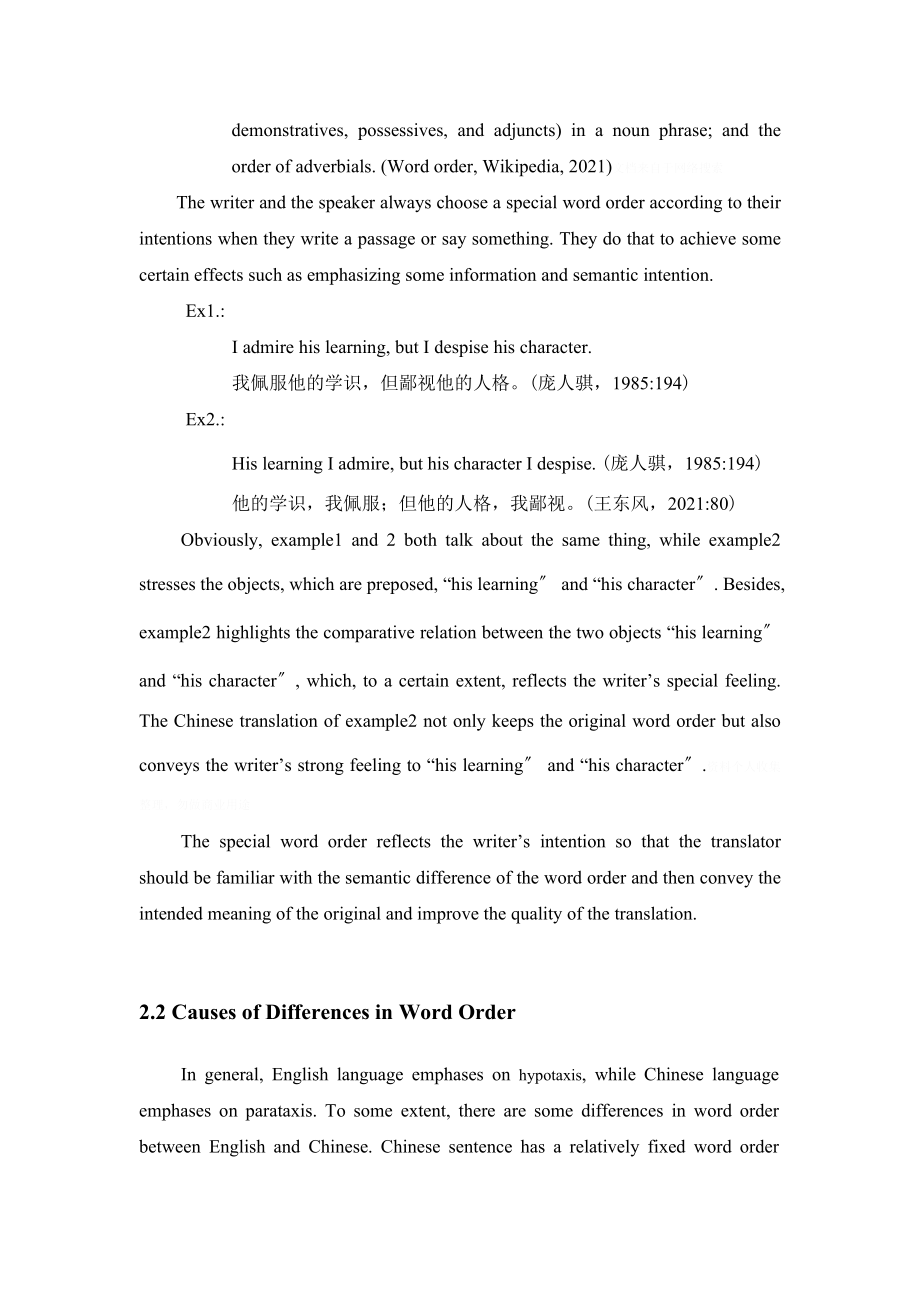
11、rders that are of interest are the constituent order of a clausethe relative order of subject, object, and verb; the order of modifiers (adjectives, numerals, demonstratives, possessives, and adjuncts) in a noun phrase; and the order of adverbials. (Word order, Wikipedia, 2021)文档来自于网络搜索 The writer a
12、nd the speaker always choose a special word order according to their intentions when they write a passage or say something. They do that to achieve some certain effects such as emphasizing some information and semantic intention. Ex1.: I admire his learning, but I despise his character.我佩服他的学识,但鄙视他的
13、人格。(庞人骐,1985:194)Ex2.: His learning I admire, but his character I despise. (庞人骐,1985:194)他的学识,我佩服;但他的人格,我鄙视。(王东风,2021:80)Obviously, example1 and 2 both talk about the same thing, while example2 stresses the objects, which are preposed, “his learning and “his character. Besides, example2 highlights t
14、he comparative relation between the two objects “his learning and “his character, which, to a certain extent, reflects the writers special feeling. The Chinese translation of example2 not only keeps the original word order but also conveys the writers strong feeling to “his learning and “his charact
15、er.资料个人收集整理,勿做商业用途The special word order reflects the writers intention so that the translator should be familiar with the semantic difference of the word order and then convey the intended meaning of the original and improve the quality of the translation.2.2 Causes of Differences in Word OrderIn g
16、eneral, English language emphases on hypotaxis, while Chinese language emphases on parataxis. To some extent, there are some differences in word order between English and Chinese. Chinese sentence has a relatively fixed word order because it does not have inflection and mainly depends on semantic co
17、llocations. However, English has such rich vocabulary and grammatical devices that its word order is relatively flexible. Furthermore, there are great differences in the sequence of time, the sequence of logic and the modifier: in terms of the sequence of time, Chinese narrative logic always narrate
18、s the actions and events according to the time they happen, while English can narrate the things either first happened or next without time limit; in terms of logic order, Chinese logic relationship usually comes from cause to result, from analysis to conclusion, from presupposition to supposition a
19、nd from condition to result, while English word order is more flexible and is often contrary to Chinese. In terms of the modifier, Chinese always put the modifier before the nouns and verbs except for highlighting something important, English is no exception.文档收集自网络,仅用于个人学习It is well known that the
20、work of a language is close to that of the thought. In other words, language is the form while the thought is the content. Actually, word order is the reflection of peoples thinking modes. As a result, differences in word order between English and Chinese are influenced by the thinking modes of the
21、two nations. Easterners emphasis on synthesis, conclusion and hint - a circle of thinking mode while westerners emphasis on logic and analysis - a one-way thinking mode. Easterners like to say some things indirectly while westerners like to say some things directly. As a result, Chinese people alway
22、s talk about the facts and then express their opinions. On the contrary, English people put forward the argument and then analyze the details and background.文档来自于网络搜索In view of the differences between English and Chinese from the perspectives of word order and thinking modes, the paper will analyze
23、the English-Chinese translation in Pride and Prejudice and its effects from three aspects: time, logic and modifier. The Arrangement of Word Order in English-Chinese Translation and Its Effects Illustrated by the Case of Pride and PrejudiceIn order to achieve certain effects like arousing the reader
24、s same feelings and exactly conveying the authors intention, translators should follow the principle of translation: the translation should be faithful to the original and be clear and coherent.The differences of word order between English and Chinese are manifested as following: the former is relat
25、ively flexible, while the latter is relatively fixed. When the writing habit of the translated text can not reach a consensus to that of the original, the translator should rearrange the word order according to the readers thinking habits. Therefore, the translator should make some proper change in
26、word order to achieve equivalence to the original and convey the original meaning. Here this paper will deal with the word order in English-Chinese translation from three aspects: time, logic and modifier.文档收集自网络,仅用于个人学习3.1 The Sequence of TimeIn the time sequence, Chinese always accords with the na
27、tural order while English always is not limited to the time order except for coordinate components.Chinese always describe what happens first, then following what happens next. Chinese word order corresponds well to time order, which will lead to the orderly arrangement of phrases. Indeed, sometimes
28、 English sentences will be made according to the sequence of time of acts and events in natural order, especially in informal English speaking communication. Under this kind of circumstance, during the process of English and Chinese translation, the translator always take the syntactic linearity to
29、translate the sentences step by step.文档收集自网络,仅用于个人学习Ex3.:He then handed her in, Maria followed, and the door was on the point of being closed; when he suddenly reminded them, with some consternation, that they had hitherto forgotten to leave any message for the ladies of Rosings.(Jane Austen,2007:25
30、2) (natural word order)然后他扶她上车,玛丽亚跟着走上去,正当车门快要关上的时候,他突然慌慌张张地提醒她们说,她们还忘了给罗新斯的太太小姐留言辞别呢。(王科一,1980:245)(natural word order).Obviously, the translator follows the natural word order and uses the same sequence of time as the writer.There are 16 kinds of tenses and many conjunctions, relative pronouns and
31、 prepositions which can indicate the time of the acts and events in English. However, there are not so many tenses in Chinese. Therefore, English and Chinese may express the sequence of time in different ways. English-Chinese translation should adjust the word order without the expense of rhetorical
32、 effects.Ex4.:Elizabeth was sitting by herself the next morning and writing to Jane, while Mrs. Collins and Maria were gone on business into the village, when she was startled by a ring at the door, the certain signal of a visitor. (Jane Austen, 2007:207) First the translator can divide the sentence
33、 into four parts:Elizabeth was sitting by herself and writing to Jane.The next morningWhile Mrs. Collins and Maria were gone on business into the village.When she was startled by a ring at the door, the certain signal of a visitor.According to Chinese thinking habits, the translator makes some prope
34、r change in the sequence of time like . Therefore, Zhang Ling 张玲and Zhang Yang 张扬 translate the sentence into“第二天早晨,柯林斯太太和玛丽亚有事到村子里去了,伊丽莎白单独一人坐在那儿给简写信,突然门铃响了起来,使她猛然一惊,这说明有客人来访。.(1995:164) From above all, when people translate English into Chinese, they should make some proper changes in the sequence
35、 of time according to the readers thinking habits and convey the authors intended meaning.3.2 The Sequence of LogicChinese always take the order of cause first and result next to express the relationship between cause and result, while English can reverse the position and often place the causes afte
36、r the results. Besides, people can place the cause phrases and clauses before if they want to emphasize on them; vice versa.Ex5.:She was roused from her seat, and her reflections, by someones approach; and before she could strike into another path, she was over taken by Wickham. (Jane Austen, 2007:3
37、75)这时已经有人走近前来,打断了她的沉思,使她从座位上站起来;她刚要从另一条小径走过去,只见韦翰却赶了上来。(王科一,1980:361) The writer first gives the result “she was roused from the seat and then explains the cause “her reflection, by someones approach. While the translator first tells readers the cause “这时已经有人走近前来,打断了她的沉思 and then describes the resul
38、t “她从座位上站起来. After rearranging the word order, the translation is easily accepted by Chinese readers.English logic order is generally to come straight to the point in judgments and comments. People always give their opinions first and then analyze the details and place the important information at t
39、he beginning in English. However, Chinese arrange the information according to the natural logic order. Chinese people always describe the events and then make a conclusion and place the important information at last. During the processing of translation, people should be sure to pay more attention.
40、 个人收集整理 勿做商业用途Ex6.:Fatigued as she had been by the mornings walk, they had no sooner dined than she set off again in quest of her former acquaintance, and the evening was spent in the satisfaction of an intercourse renewed after many years discontinuance. (Jane Austen, 2007:297)上午那趟徒步旅行已经弄得她精疲力竭,可是她
41、刚一吃完饭,就出去寻访她的故交,和阔别多年的老友重逢叙旧,这天晚上过得非常满意。 (张玲 张扬,1995:236)Jane Austen first gives Mrs. Gardiners feeling “fatigued and then tells the readers the reason “she had been by the mornings walk. While the translators first describe the events “上午那趟徒步旅行and then talk about the feeling “弄得她精疲力竭 according to t
42、he readers thinking habits in Chinese.3.3 The Modifier Modifier, grammatically, refers to a word, such as an adjective or adverb, which describes another word or group of words, or restricts its /their meaning in some way. (Oxford advanced English Chinese Dictionary, 2004:1117). People always put th
43、e modifiers before or after the nouns and verbs to highlight and lay stress on the character of the nouns and verbs. The translator may adjust the word order in order that the translation is equivalent to the original text and reach the equivalent rhetorical effects. The effect of the original modif
44、ier in the sentence may not be equally conveyed by following the original word order in the translation. To achieve the equivalent rhetorical effects like emphasis, Chinese translator may adjust the word order by the split translation. This part focuses on the rearrangement of adverbial modifier and
45、 adjective modifier.资料个人收集整理,勿做商业用途Ex7.:I am confident that she would have performed delightfully. (Jane Austen, 2007:202) 我相信她演奏起来,一定动听。(王科一,1980:197)The writer puts the verb “performed and the adverbial modifier “delightfully together, while the translator divides them and puts the adverbial modif
46、ier “一定动听alone. They both highlight the effects of the verb “performed.Ex8.: The Lucases are very artful people indeed, sister. (Jane Austen, 2007:163) Chinese translation: 真的,弟妹,卢卡斯这一家子可鬼呢。(张玲 张扬,1995:131) The writer follows the collocation of the adjective modifier and the noun so that she puts th
47、e adjective “very artful before the noun “people. While the translators put the adjective modifier “可鬼呢after the noun “卢卡斯这一家子. The translation highlights the Lucases artful tactics. The above discussed aspects like the sequence of time, the sequence of logic and the modifier in translation is to equally convey the original text and represent the rhetorical effects. Chinese translator may adjust the word order as required. The purpose of the discussion here is hoped to make the translation easily accepted by Chinese readers and help Chinese readers b
温馨提示
- 1. 本站所有资源如无特殊说明,都需要本地电脑安装OFFICE2007和PDF阅读器。图纸软件为CAD,CAXA,PROE,UG,SolidWorks等.压缩文件请下载最新的WinRAR软件解压。
- 2. 本站的文档不包含任何第三方提供的附件图纸等,如果需要附件,请联系上传者。文件的所有权益归上传用户所有。
- 3. 本站RAR压缩包中若带图纸,网页内容里面会有图纸预览,若没有图纸预览就没有图纸。
- 4. 未经权益所有人同意不得将文件中的内容挪作商业或盈利用途。
- 5. 人人文库网仅提供信息存储空间,仅对用户上传内容的表现方式做保护处理,对用户上传分享的文档内容本身不做任何修改或编辑,并不能对任何下载内容负责。
- 6. 下载文件中如有侵权或不适当内容,请与我们联系,我们立即纠正。
- 7. 本站不保证下载资源的准确性、安全性和完整性, 同时也不承担用户因使用这些下载资源对自己和他人造成任何形式的伤害或损失。
最新文档
- 高校学生移动支付感知风险与接受度的关联性探究
- 高校图书馆虚拟参考咨询服务:现状、挑战与创新发展路径探究
- 高校兼职教师队伍建设的现状剖析与路径探索
- 高旋弹弹旋基准实时测量装置:原理、设计与应用研究
- 高新技术产业上市公司融资结构对投资行为影响的深度剖析与实证检验
- 驾校安全管理台账管理细则
- 初级养老护理员理论考试题及答案
- 街道流动人口管理制度
- 驾校学员安全文明驾驶教育制度
- 幼儿保健医生考试题库及答案
- 2026江苏苏州市相城区人力资源和社会保障局招聘编外人员3人笔试备考试题及答案详解
- 2026安徽九华山旅游发展股份有限公司招聘82人考试备考试题及答案详解
- 手术室人文关怀实践分享
- 2026浙江舟山市定海区城东街道办事处第二批招聘城市管理辅助人员3人考试备考试题及答案详解
- 施工应急资源调配方案
- (期末复习) 2025-2026学年下学期人教版八年级下册数学期末 练习试卷
- 2026年四川成都市初中学业水平考试历史试卷真题(含答案)
- 小儿心肌炎诊疗指南(2025年版)
- 2026中国信达浙江分公司社会招聘笔试参考题库及答案详解
- 2026年装配钳工职业技能鉴定考试题库及答案
- 初中化学练习题07溶液及溶解度(原卷版)
评论
0/150
提交评论