毕设说明书.pdf

发动机配件生产线自动上料系统设计【11张CAD图纸和毕业论文】【答辩优秀】

收藏

资源目录
跳过导航链接。
发动机配件生产线自动上料系统设计【全套CAD图纸和毕业论文】【答辩优秀】.rar
毕设说明书.pdf---(点击预览)
任务书.doc---(点击预览)
2014年毕业设计(论文)开题报告.doc---(点击预览)
2014年机电工程学院毕业设计(论文)进度计划表 (1).doc---(点击预览)
CAXA图纸
主机架1.exb
固定板.exb
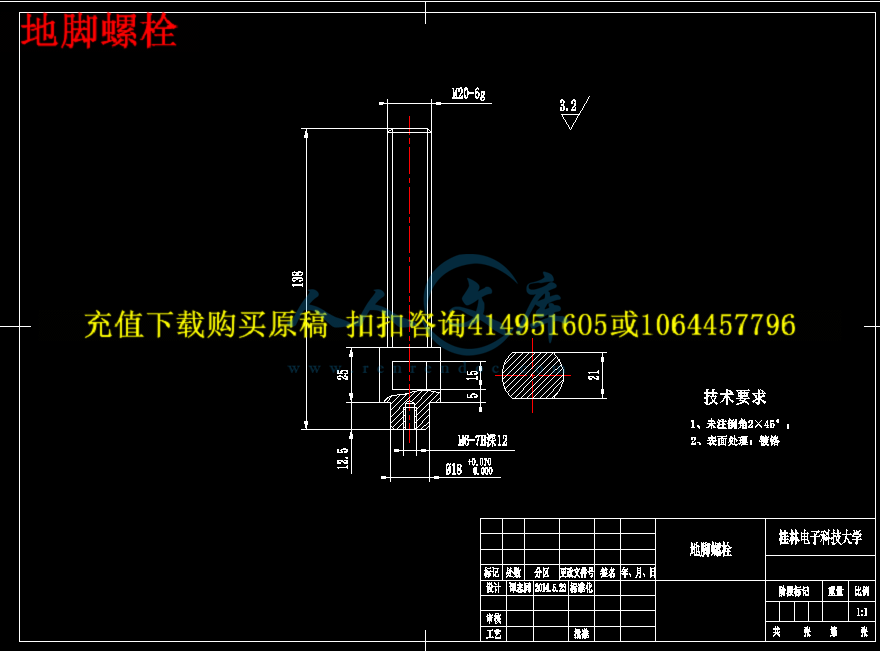
地脚螺栓.exb
左右臂板.exb
张紧螺杆.exb
总装配图.exb
推杆机构装配图.exb
轴1.exb
链轮.exb
链轮1.exb
顶梁杆.exb
翻译
主机架1.dwg
固定板.dwg
地脚螺栓.dwg
左右臂板.dwg
张紧螺杆.dwg
总装配图.dwg
推杆机构装配图.dwg
轴1.dwg
链轮.dwg
链轮1.dwg
顶梁杆.dwg
压缩包内文档预览:(预览前20页/共39页)
预览图 预览图 预览图 预览图 预览图 预览图 预览图 预览图 预览图 预览图 预览图 预览图 预览图 预览图 预览图 预览图 预览图 预览图 预览图 预览图
编号:475515    类型:共享资源    大小:4.83MB    格式:RAR    上传时间:2015-08-30 上传人:好资料QQ****51605 IP属地:江苏
45
积分
关 键 词:
发动机配件 生产线 自动 系统 设计 全套 cad 图纸 以及 毕业论文 答辩 优秀 优良
资源描述:


在汽车零配件加工生产的过程中,如果使用人工上下料,则其不仅劳动强度大,而

且效率低,工作环境也较差,有诸多不足。而使用自动上下料装置,则具有传送快速、

定位精度高以及可以长时间连续作业,大大提高了生产效率。

本文拟设计一个适合于发动机配件生产线自动上料系统,该系统主要包括链传动系

统和偏置曲柄滑块推杆机构两个部分。

在链传动系统中,选用合适的三相异步电机和与之匹配的减速器,再选择合适的间

歇分割器,实现间歇传动,再通过一组链传动,从而实现预定减速。链传送带上的链条

选择带翼的 08B 链条,翼上可以安装托盘,托盘上放置运输件,当链条转动时可以实现

运输上料,链传送带上有张装置,可以保证从动链轮与主动轮在同一水平线上,且能保

证链条的张紧。

在偏置曲柄滑块推杆结构中,在推杆位置末端放置接近开关传感器,当输送件到达

指定位置时,接近开关感应输出信号给予步进电机信号,步进电机转动,带动设计的偏

置曲柄滑块机构实现直线运动,完成推杆动作。设计的链传动与推杆形成配合完成自动

上料系统。


关键词:发动机配件:自动上料:间歇:链传动;偏置曲柄滑块机构;


Abstract


*In the process of automotive parts production,If you use the manual loading,then

it is not only a Labor-intensive,but also inefficiencies,and the working environment is poor ,

there  are  many  deficiencies.However, the  use  of automatic  loading and  unloading devices,

with transfer speed, high precision and long-time continuous operation, greatly  improving

production efficiency.

         This paper  intends to design  a  suitable engine parts production line  automatic

feeding systems. The system consists of two parts chain drive and   the putt of    offset crank

slider mechanism.

In the chain of transmission system,, choice the appropriate of three-phase asynchronous

motors and matching  reducer. Then select the  appropriate intermittent segmentation to

achieve  intermittent drive, and then achieve  a  predetermined deceleration through  a  set of

chain drive. Chain links on the conveyor belt will select the chain links of winged 08B, the

wing  may  be  mounted the  tray. The  tray  is placed on the  transport pieces. When the  chain

rotating , transporting the material can be achieved. There tensioning device on the conveyor

of chain can ensure driven sprocket and active wheel at the same level, and can ensure that the

chain tension .

   In the the putt of    offset crank slider mechanism,at the end of the push rod position,

the sensor is placed close to the switch. When transporting pieces arrived at the designated

location, proximity switch sensor output signal that is given to the stepper motor, the stepper

motor rotating, and offset slider-crank mechanism drives by the design of linear motion. Then

pushing  rod action is completed . The  chain drive and putting  of  designed form with the

completion of automatic feeding systems.


Keywords:Engine parts: Automatic feeding: Intermittent: Chain drive; Bias slider-crank

mechanism;putter


*目


目    录 ............................................................................................................................. III

1       引言 .......................................................................................................................... 1

*1.1自动送料机构的背景与发展前景 ..................................................................... 1

2       总体方案设计 .......................................................................................................... 3

2.1 课题设计方案对比 ............................................................................................ 3

2..1.1 方案一 ................................................................................................... 3

2.1.2 方案二 ..................................................................................................... 4

2.1.3 方案三 ..................................................................................................... 5

2.2 总方案结构设计思路 ........................................................................................ 6

3     机械元件的选择与设计计算 .................................................................................... 7

*3.1链传动系统设计 ................................................................................................. 7

3.1.1  链条的选择 ............................................................................................ 7

3.1.2  链轮的设计与计算 .............................................................................. 10

3.1.3 链轮的连接与装配 ............................................................................... 15

3.1.4 轴的校核 .............................................................................................. 15

3.1.5 链轮张紧装置的设计 ........................................................................... 17

3.1.6 链传送带框架设计 ............................................................................... 17

3.1.7 托盘设计 .............................................................................................. 18

3.1.8 顶梁杆设计 ........................................................................................... 19

3.1.9 调节杆设计 ........................................................................................... 19

3.1.10 支撑钢板设计 ..................................................................................... 20

3.1.11 臂板设计 ............................................................................................ 21

*3.2推杆的设计与计算 ........................................................................................... 21

3.2.1 推杆行程计算 ...................................................................................... 22

3.2.2 曲柄连杆的设计 .................................................................................. 22

3.2.3 垫片设计 ............................................................................................... 23

3.2.4 转盘以及固定钢板设计 ...................................................................... 23

3.2.5 直线轴承的设计选择 .......................................................................... 24

3.2.6 推杆末端组合件设计 .......................................................................... 25

4   电气元件的选择计算 ................................................................................................ 27

*4.1用于链传动的电动机的计算与选择 ............................................................... 27

4.1.1 链传动台的摩擦力的计算 .................................................................. 27

4.1.2  扭矩、功率、减速比的计算以及电机的选择 ................................ 28


*4.2推杆的电动机的计算与选择 ........................................................................... 29

5   总结 .......................................................................................................................... 31

谢    辞 .............................................................................................................................. 32

参考文献 .......................................................................................................................... 34


1        引言


*1.1自动送料机构的背景与发展前景


送料机是一种与冲床配套的空气自动送料机,有一个主体,主体连接导柱的一头,

导柱的另一头连接进料组件,主体中制有送料机构、固定夹料机构、控制机构和传递机

构,传递机构与冲床凸轮或模具相配合,导柱上安装活动夹料机构,活动夹料机构与送

料机构相连。自动送料机可送金属片、非金属片及线材、管材等,送料误差小、速度高,

不需人工直接用手送料操作,有效地保护生产安全和减轻劳动强度,减少工资支出。


上料机是我国机械行业的一大特色,我国上料机机械设备的生产迄今已有几十年的

历史。随着国产化技术水平的提高和引进先进的机械制造设备和加工工艺,上料机设备

工业近20年来得到了飞速的发展。


*机械制造自动化这是送料机、电气化与自动控制相结合的结果,处理的对象是离

散工件。早期的机械制造自动化是采用机械或电气部件


内容简介:
毕业设计(论文)中期检查表(指导教师) 指导教师姓名: 唐焱 填表日期: 2014 年 4 月 17 日 学生学号 10000110127 学生姓名 谭志同 题目名称 发动机配件生产线 自动上料系统设计 已完成内容 2013.12.17-2014.1.4 理解课题,完成开题报告。 2014.1.5-2014.4.1 查阅相关资料,对设计中所需知识进一步了解。 完成外文翻译。 2014.4.2-2014.4.21 确定自动 上料系统的基本结构。 检查日期: 2014 年 4 月 22 日 完成情况 全部完成 按进度完成 滞后进度安排 存在困难 1. 综合考虑现有条件、需求、技术、经济等方面的影响因素, 如何 制订设计总体方案; 2. 对于上料系统的结构设计与分析。 3. 起止电机的选择。 4. 上料系统如何实现配合统一。 解决办法 查阅资料,认真思考,求教指导教师,多多学习与改正。 预期成绩 优 秀 良 好 中 等 及 格 不及格 nts建 议 教师签名: 教务处实践教学科制表 说明: 1、 本表由检查毕业设计的指导教师如实填写; 2、 此表要放入毕业设计(论文)档案袋中; 3、 各院 (系 )分类汇总后报教务处实践教学科备案。 nts 编号: 毕业设计 (论文 )外文翻译 (原文 ) 学 院: 机电工程学院 专 业: 机械设计制造及其自动化 学生姓名: 谭志同 学 号: 1000110127 指导教师单位: 机电工程学院 姓 名: 唐焱 职 称: 副教授 2014 年 5 月 26 日 nts A novel data decomposition and information translation method from CAD system to virtual assembly application Abstract Virtual assembly (VA) is a key technology for virtual manufacturing systems. So far, CAD systems are still the main modeling tools for the VA system. There isnt a standard data ex-change criterion to transfer the data directly from CAD systems to VA applications, consequently an original data decomposition and information translation method (DDITM) was timely proposed to achieve the decomposition and translation. The information of the assembly bodies in the CAD system was divided into geometry information, topology information, and assembly information, etc., which were transferred to the VA application separately. The geometry information including the surface information was translated by the data translation interface (DTI) developed, the topology information was translated by a five-hierarchy topology structure (FHTS) constructed, and the assembly information was translated with database technology. A systematic architecture was formed with the interaction between the geometry information and the topology information, and the assembly information and the topology. Finally an experimental VA system was set up to verify the DDITM, and an assembly simulation was implemented to verify the assembly information further, which proves the translated information is precise and sufficient. Keywords CAD Data decomposition Information translation Virtual assembly 1 Introduction Virtual environments (VE) are interactive virtual image graphics displays enhanced by special processing and non-visual tools, such as auditory and haptic ones, to realize the effect of immersion regarded as a natural extension to three-dimension graphics technology with advanced input and output equipments. There are four key characteristics immersion, presence, navigation and interaction that are usually used to measure and classify different VR systems and the applications 1, which have affected and changed peoples ways of thought and action manners greatly. VR has already become one of the most advanced, powerful technologies, employed in a variety of fields, such as military, medicine, entertainment, architecture and mechanical manufacturing, etc. Virtual assembly (VA) is a concrete application of VR. Assembly technology plays an important role in manufacturing, which is not only a key step in product design and producing, but also the last step in gaining a whole performance. Some analyses show that assembly-related activities in manufactured goods account for over 50% of the total production time and 2040% of the unit production cost 2. The development of VA based on VR provides us a low-cost and rapid method for assembly, which employs visualization technology, simulation technology, assembly technology and decision-making theory, etc. After the components designs are finished, the data of these CAD models are transferred to nts the VA to implement assembly evaluation, assembly simulation, and assembly planning or assembly evaluation. Then invalid irrational structures are improved, and relative engineering decisions pertaining to assembly are made, so as to assure a success of actual assembly process. Consequently the product development cycle is shortened and costs are reduced, and the assembly efficiency is improved, too. Assembly modeling is the first step to construct a VA system. Although VR software has a certain modeling ability to create some simple geometrical shapes (e.g., cylinder, cube, sphere etc.), it cannot meet the modeling requirements if relying only on VR software to build complex shapes or if thousands of components are to be built. So far 3D CAD softwares (e.g., SolidWorks, Pro/Engineer, and Unigraphics, etc.) are the still main modeling methods for VA system. In this paper we use SolidWorks to build CAD models. There isnt a standard data exchange criterion between the CAD system and VA system, so the information of CAD models cant be transferred to VE directly. Although the CAD system can export the CAD graphical models in other formats (e.g., WRL, DXF, 3DS, SLP, etc.) imported into VE and displayed there. However, these formats can only keep partial geometry information etc. For example, the whole assembly body or a single component can be selected, but its surfaces cannot be selected, so the models in these formats are only of the concept of body and not of that of surface in VE. However surface is such an important concept in assembly, and it has to serve such functions as follows: (1) orienting components or assembly bodies, (2) defining constraints, (3) defining joints, (4) defining geometrical and dimensional tolerances, (5) defining precision or roughness, and (6) defining physical information (e.g., colors and materials etc.). Without the surface concept, the assembly concept becomes vague and the VA system is also reduced to a simple simulation application. In addition, the VA system needs not only geometry information, but also topology information, assembly information, etc. So transferring the information of these CAD models to VA is not only the first step of constructing a VA system, but also a key step having an influence on the display effect, the assembly effect, and the precision requirements of the VA system. In the next section, several data translation methods of assembly-related VE are introduced. In Sect. 3 an introduction to the DDITM structure is given. In Sect. 4, a concrete realization algorithm for the DDITM is proposed. In Sect. 5 an experimental VA system and an assembly simulation system are setup to verify the translated information. Conclusions are made in Sect. 6. nts 2 Related works The previous research on translating the information of CAD models into assembly-related VE can be classified into several categories. The first is about the use of the VRML file as a transformational file, as it is employed in most of the VA systems. One representative work of this category is from the National Institute of Standards and Technology 3, where they developed a VRML interface for a system called visual interface to manufacturing (VIM). This system provides visual access, using VRML, to a database containing manufacturing data. Antonishek 4 also used VRML as a bridge between the CAD system and Virtual Workbench. STEP, a graphical data exchange standard, forms the second category, which is employed to translate complex assembly data. Mok 5 developed a CAD/CAM/CAE product data management (C3P) tool based on a structural product coding system (SPCS). The C3P system analyzed a product by importing information from its STEP CAD data. Lee 6 presented a system focusing on shape representation and interoperability of product models for distributed virtual prototyping, where STEP was used as a means of transferring and sharing product models. Ikonomov et al. 7 proposed a virtual assembly model for concurrent engineering using STEP data exchange. The third category integrates the modeling system with the VA system, both of which share a common database. Wan et al. 8 described VDVAS, an integrated multi-modal virtual design and virtual assembly environment. One important feature of VDVAS lies in that it allows designers to modify components of an assembly during the process of assembly modeling and simulation without the need of time-consuming data exchange between the virtual environment and other CAD applications. The fourth category focuses on using the interface software. Two typical VA instances are introduced here. These two systems are virtual environment for design and manufacturing (VEDAM) 9 and virtual assembly development environment (VADE) 10. VEDAM is a very general framework for virtual reality applications in design and manufacturing, whereas VADE is specifically designed for assembly planning. The two systems have chosen Pro/Engineering as their modeling systems and obtained the information through automated transfer from the CAD system using Pro/DEVELOP, the developers toolkit for accessing the Pro/Engineer database. Many other formats are also used to transfer the information of CAD models into other VE, such as “OpenFlight”, “DXF”, “ 3DS”, “SLP”, and so on. Weyrich et al. 11 presented an approach of a “virtual workbench” and its application to virtual assembly. The system used the professional modeling tool Multigen II, and the “OpenFlight” format as its data interface with the virtual environment. nts 3 Structure of the DDITM The methods introduced in Sect. 2 have both pros and cons. The first kind is easier to realize, but the VRML in this way doesnt provide assembly information and the surface concept is lost, so it is hard to perform complex assembly actions in VA. STEP includes almost all the information of CAD models from design period to assembly period, but its structure is so complex that the needed information is too difficult to extract. The third kind spends less time on data translation between the CAD system and VA system, but it needs to a create modeling system itself, so excessive time is spent on developing a modeling system, moreover the integration between the system and current CAD system is not good enough. Other formats have the same problem as VRML. In this paper, according to the research on the above techniques, an information decomposition and translation method (DDITM) is proposed to translate the information of CAD models to the VA system. The DDITM divides the data into several sections: geometry information, topology information and assembly information, which are translated through different methods. Figure1 shows the translation flowchart of DDITM. 1. As for geometry information, the surfaces of the CAD models are discretized into triangle tessellations by means of the CAD forward development method, and then these tessellations information is written into corresponding VR documents through the DTI. In VA, when all these triangle tessellations are displayed, continuous geometry entities nts are reconstructed. In addition, the surfaces of the CAD models are treated as separate objects in these VR documents. By creating the relations between surfaces and tessellations, the surface concept is constructed in VE. 2.As for topology information, this paper uses a topology structure named five-hierarchy topology structure (FHTS) to store the topology information of the CAD models. The FHTS includes five hierarchies, i.e., assembly, subassembly, part, surface, and tessellation. First, three tables are constructed to realize the FHTS, which are a subassembly table, a part table and a surface table. Then each hierarchys information extracted from the CAD system is stored into the corresponding table by using the CAD forward development method. 3. As for assembly information, database technology is adopted. Two tables including mate table and tolerance table are constructed. Assembly information (including mate information, tolerance information) is taken out of the CAD system by using the CAD forward development method, and then stored into corresponding tables. 4. The assembly information, the geometry information and the topology information do not exist separately, instead they interact with each other. The FHTS is a kernel part of the DDITM, which is used as a bridge to link the geometry information and the assembly information, and both of them interact with the FHTS to share the information with each other. After constructing the surface concept, a surface will be treated as a basic unit to perform VA operations. nts 4 Realization of the DDITM 4.1 Software platform To realize the DDITM SolidWorks 12 is selected as the assembly modeling platform, WorldToolKit (WTK) is selected as the platform for constructing the VA system 13, SQL Server is selected as the database platform, and Visual C+ is selected as theapplication developing platform. Both SolidWorks forward development method and the WTK select Visual C+ as a supporting platform, which can eliminate the compatibility problems between them. 4.2 Geometry information translation based on surface hierarchy 4.2.1 Selection of VR document format The DDITM uses the DTI to write the geometry information of SolidWorks models into corresponding VR documents loaded into VA as geometry nodes. Then the geometry entities are displayed in VA with the display mechanism of WTK. VR document interfaces (e.g., NFF, 3DS, WRL, DXF, and SLP etc.) are used to transfer geometry information from any other kind of CAD modeling software to VA. Although WTK supports many VR formats, only the WRL format can be used to transfer geometry information from SolidWorks to VA, but in a practical application, the WRL document is of the following limitations in WTK 13 1. In WRL documents, although CAD models are discretized to triangle tessellations based on a surface hierarchy, the surfaces have no identities, so WRL documents do not have the surface concept, consequently WTK cant modify the colors or the textures etc. of the surfaces. Therefore the surfaces in VA cant be picked up so that the assembly actions based on surfaces cant be performed. 2. WTK ignores scaling factors (if any) within a transform nodes transformation. WTK cant perform scale operations on WRL virtual objects, so the size of virtual objects cant be changed according to the objects in VA or they cant make more examples of different sizes. 3. Virtual objects of WRL documents are of only the body concept and the tessellation concept, so if precise collision detection is performed, its efficiency will be low, for intersection test between every two tessellations has to be performed. WTK Neutral File Format (NFF), another VR document format is adopted to discretize bodies into aggregates of triangle tessellations. The NFF format, written in ASCII format, is a neutral file format taken by WTK. Compared with the WRL documents, the NFF documents include all the geometry information that the WRL documents have. In addition, if every surface is treated as an separate object in NFF documents and identified by a unique identity, then the surface information is constructed. The surface information is very important because assembly information is based on the surfaces, and the assembly information, the topology information, and the geometry information communicate with each other based on surface hierarchy, too. Furthermore NFF documents are integrated into WTK closely, so there arent any limitations for them in VA. In short, the NFF is the best VR format to store the geometry information including the surface information. 4.2.2 Creating NFF documents Although NFF documents are selected to store the geometry in formation, SolidWorks nts doesnt provide the interface to export the NFF documents, hence the DTI is developed here. It extracts the information of the WRL documents created by SolidWorks and writes this information into corresponding NFF documents. At the same time, the DTI employs the CAD forward development method to write other geometry information including surface in formation to corresponding NFF documents. The flow chart of the DTI is as shown in Fig. 2. First, a pretreatment is implemented to record the count of discrete points and that of the triangle tessellations for each surface, which are stored in two variables. Second, write file heads that include some recognition information of NFF documents (e.g., NFF tag, NFF version number, position of view point, orientation of viewpoint, etc.). These file heads are used to mark the NFF documents. Third, the surfaces information is extracted from WRL documents and written into corresponding NFF documents. In this stage, each surface of the CAD models is treated as an individual object numbered consecutively. We also need to write the information obtained from the pretreatment stage into a corresponding NFF document. Then, the concrete information is written into corresponding NFF documents extracted from the WRL documents by reading these WRL documents line by line. This information includes the number of the discrete points, their coordinate values, an automatic symbol “N” taken to calculate the normal of the tessellation automatically, the material information and tessellations information etc. Each triangle tessellation has a unique identity numbered consecutively. Finally, judge whether it is the last surface, if it is nts false, repeat the former process, or else finish reading these WRL documents and creating the NFF documents at last. In VA, a NFF document is loaded into WTK as a geometry node and all the objects in the document are displayed in VA respectively. Each surface includes corresponding tessellations. After constructing the FHTS, the relationship between a surface and tessellations will finally be constructed. Then the surfaces information of these models will be built, and the operations on surfaces will be converted into the operations on corresponding tessellations. For example, the change of a surfaces texture will be converted into the change of its corresponding tessellations texture and the change of a surfaces color will be converted into the change of its corresponding tessellations color. Thus through the DTI we translate the geometry information based on surface hierarchy from the CAD system
温馨提示:
1: 本站所有资源如无特殊说明,都需要本地电脑安装OFFICE2007和PDF阅读器。图纸软件为CAD,CAXA,PROE,UG,SolidWorks等.压缩文件请下载最新的WinRAR软件解压。
2: 本站的文档不包含任何第三方提供的附件图纸等,如果需要附件,请联系上传者。文件的所有权益归上传用户所有。
3.本站RAR压缩包中若带图纸,网页内容里面会有图纸预览,若没有图纸预览就没有图纸。
4. 未经权益所有人同意不得将文件中的内容挪作商业或盈利用途。
5. 人人文库网仅提供信息存储空间,仅对用户上传内容的表现方式做保护处理,对用户上传分享的文档内容本身不做任何修改或编辑,并不能对任何下载内容负责。
6. 下载文件中如有侵权或不适当内容,请与我们联系,我们立即纠正。
7. 本站不保证下载资源的准确性、安全性和完整性, 同时也不承担用户因使用这些下载资源对自己和他人造成任何形式的伤害或损失。
提示  人人文库网所有资源均是用户自行上传分享,仅供网友学习交流,未经上传用户书面授权,请勿作他用。
关于本文
本文标题:发动机配件生产线自动上料系统设计【11张CAD图纸和毕业论文】【答辩优秀】
链接地址:https://www.renrendoc.com/p-475515.html

官方联系方式

2:不支持迅雷下载,请使用浏览器下载   
3:不支持QQ浏览器下载,请用其他浏览器   
4:下载后的文档和图纸-无水印   
5:文档经过压缩,下载后原文更清晰   
关于我们 - 网站声明 - 网站地图 - 资源地图 - 友情链接 - 网站客服 - 联系我们

网站客服QQ:2881952447     

copyright@ 2020-2025  renrendoc.com 人人文库版权所有   联系电话:400-852-1180

备案号:蜀ICP备2022000484号-2       经营许可证: 川B2-20220663       公网安备川公网安备: 51019002004831号

本站为文档C2C交易模式,即用户上传的文档直接被用户下载,本站只是中间服务平台,本站所有文档下载所得的收益归上传人(含作者)所有。人人文库网仅提供信息存储空间,仅对用户上传内容的表现方式做保护处理,对上载内容本身不做任何修改或编辑。若文档所含内容侵犯了您的版权或隐私,请立即通知人人文库网,我们立即给予删除!